
Many entrepreneurs are plagued with low visibility, poor conversion rates, and unqualified buyers.
And paid advertising doesn’t seem to fix the issue; in fact it seems to be making things worse.
Believe it or not, you’re entirely too focused on the wrong things. Artificial intelligence is looking for a mixture of technical assets, page specific editorial content, and off-site validation; So if you’d like to increase AI visibility, and qualified traffic to your website, you’ll need the following:
Structured Data Called Schema
Clear, Information-Dense On-Page Content
Regularly Published Educational Material Across Multiple Platforms
Third Party Reviews, Citations, And Mentions On Reputable Industry Websites (Directories)
1. Schema & Site Structure
When an AI crawler or search engine looks at your website, it doesn’t see the same pages that we do. It reads lines of code, folders, and ordered HTML tags to understand what information is important and why. Think “The Matrix” in real-life. Increased visibility starts with the proper structure, coding, and indexing of those pages.
Structured Data Markup
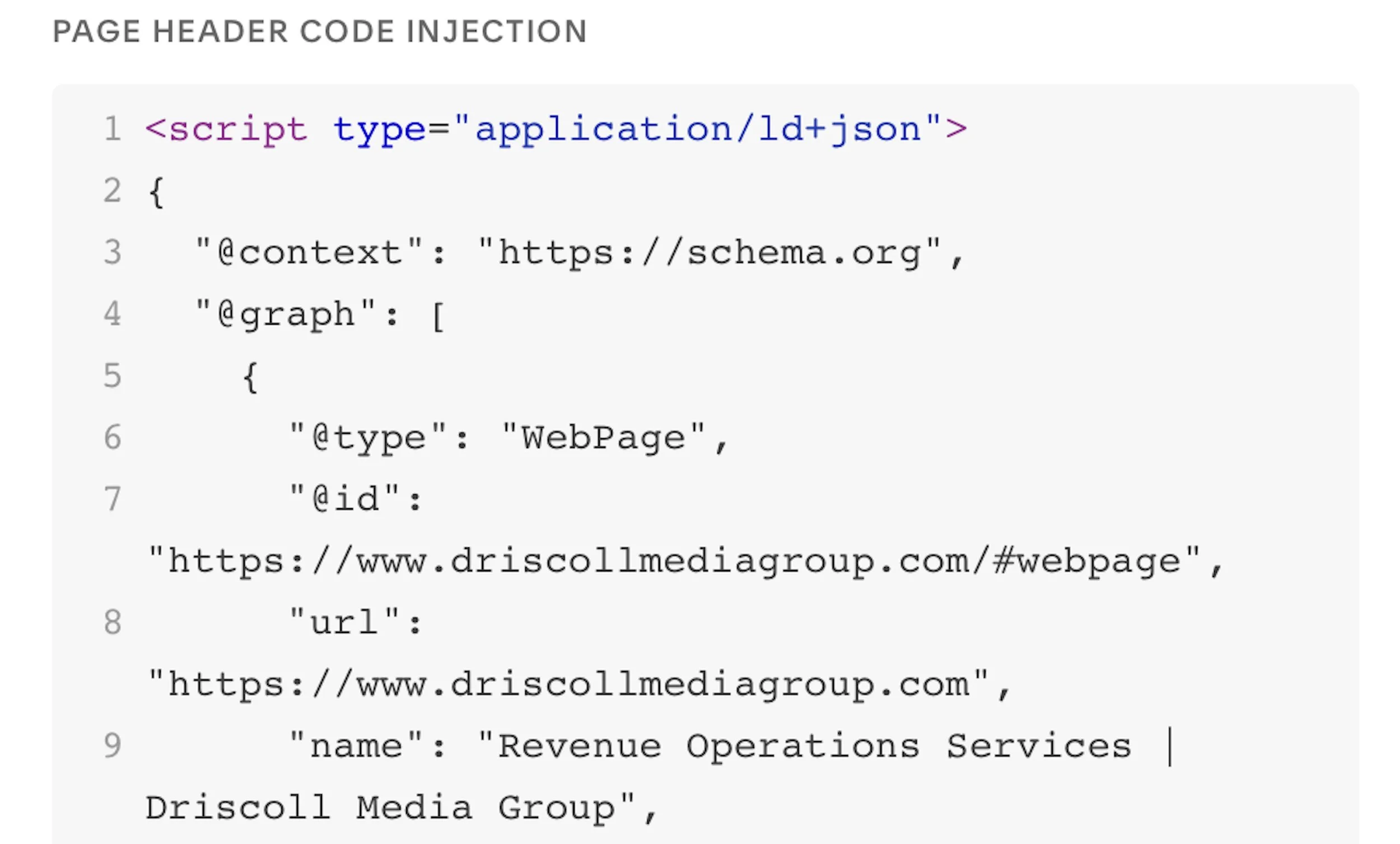
Schema is machine-readable code, like JSON-LD (JavaScript Object Notation for Linked Data), that explicitly defines your business entity, contact information, locations, services, specialties, authorship, and even audience segments.
The framework of your schema should clearly organize each page around a global organization template, a local business listing, and the website as an asset with services and offers.
Structured schema is a critical component to machine understanding of who you are, and what you do; ensuring AI models do not confuse your business with a competitor, or misinterpret service areas.
Organized URL Slugs
Your website uses folders to store information. These folders are labeled with URL slugs, like /case-studies or /about.
Logical, keyword-relevant URL slugs help AI crawlers understand how your website is organized, and what information can be found on each page. The AI crawler will parse this information to quickly select the most relevant page on your website to a user’s search query.
This makes URL slug structure an essential component in relevancy and accuracy of results. Think of the URL slug as a qualifying conversation before you set a sales call.
Semantic HTML Hierarchy
HTML tags and ordered headings show AI how information is structured and prioritized on the page itself.
Each HTML tag, (like H1, H2, or H3), creates a hierarchy to the information contained. Proper structure of these tags, including bullet pointed lists, and comparison tables can break that content into clear, logical chunks of information that AI can parse and cite during relevant searches.
This tells AI exactly which portions of your content it should serve as a result, and how closely that information represents the rest of the information on the specific page it was pulled from.
— —
Pro Tip: Modern AI search engines like Google AI Overviews and Perplexity parse images alongside text. The metadata of those images will reinforce the topical authority, trust, and relevancy of the information on the page.
Use non-AI generated images which are directly relevant to the information they are used with. Label the images with logical, keyword specific filenames, and reinforce authority with Image Alt Text that is accurate to the image itself.
Ensure fast loading times by using JPEG, WebP, or AVIF formats, and <1MB file sizes.
Instead of “Image_4964.png” change the filename to something short and descriptive like “inside-sales-representative.jpg”.
Do not over-use background images. Simplicity is always better.
2. Market Positioning & Alignment
Before AI will recommend you to potential buyers, you must first make your case to the machine gods; just kidding. But you will need to demonstrate topical authority, depth of understanding, and consistent, unique positioning across multiple platforms; giving AI search engines a clear reason to recommend you instead of generic competitors.
Market Positioning & A Clear Niche
Every business needs a USP, (Unique Selling Proposition), that clearly defines the differentiating value it brings to the marketplace. And that starts with an extremely clear definition of your target market, what problems you solve, the exact solutions you offer, and where you serve those customers.
Your messaging should establish market positioning by clearly communicating those differentiating points, and how they benefit your target market.
Artificial Intelligence will compare your positioning against your competitors’ positioning and recommend the business who most accurately represents its interpretation of the buyer’s search intent.
Information Density & Accuracy
You should use clear, concise language to outline your unique market positioning on both your website and throughout your schema. This ensures that Artificial Intelligence knows why it should recommend your company and your specific solution, instead of your competitors.
When parsing information, AI search engines will naturally gravitate towards fact-rich copy, written with high information density. This usually means there is a significant amount of specific detail in each sentence.
For Example:
We’re located in downtown Greensboro.
We’re located in downtown Greensboro, North Carolina.
We’re located at 101 S. Elm St. in downtown Greensboro, North Carolina.
We’re located in Suite 200, at 101 S. Elm St. in downtown Greensboro, North Carolina.
Driscoll Media Group is located in Suite 200, at 101 S. Elm St. in downtown Greensboro, North Carolina.
Including organizational and entity specific details like your company name and suite number will reinforce who and where you are with AI, leaving zero doubt or room for confusion with other companies.
Topical Authority
Topical authority, specifically educational content, can be broken up into three core concepts; comprehensive depth, breadth, and consistency.
Artificial Intelligence heavily favors expert-level content and analysis focused on answers to nuanced questions, and deeper, more thoughtful responses. Surface level summaries will get buried without reference.
Publishing multiple pieces of related content that combine to form an overarching synergy between your services will prove to AI that you are an established subject matter authority with a defined strategy and the execution ability to carry it out.
Regularly post and update content to signal crawlers that your expertise is active, current, and most importantly, reliable.
— —
Pro Tip: Create a proprietary framework, like the RevenueCore Marketing System or Apple’s iOS Operating System, that outlines your unique processes or viewpoints to help AI understand how your methodology is different.
3. Third Party Validation
One of the most underutilized strategies in business is that of third-party validation. Artificial Intelligence will actively cross-reference dozens of platforms, directories, and unrelated media accounts looking for mentions that are relevant to a specific user’s search query, and an attached brand reference. You may want to use this to your advantage.
Trusted Platforms
Established platforms like Google, the Better Business Bureau, LinkedIn, Yelp, Clutch, and G2 are all existing reference points used to verify real-world customer feedback, ratings, use cases, and general sentiment before a recommendation is given.
Reputable Industry Directories
Niche B2B directories, local Chambers of Commerce, or industry associations like the National Foundation Repair Association and the American Marketing Association can offer additional insights to an AI crawler looking for consistent business information.
Earned Media Mentions
And finally, Artificial Intelligence is actively looking for a media-driven company that cares about its public reputation and image. As a result, it searches outside sources like podcasts, trade publications, and local or regional business journals for the specific company that can offer a solution, experience, and relationship that matches the search intent of the potential customer.
— —
Pro Tip: Ask your customers to include the following information in their reviews:
The specific problem they had before hiring you.
The exact solution or service they received, plus what helped them the most.
The process and experience your team provided, and the biggest change they’ve experienced as a result.
Any measurable results, or tangible outcomes they got from your services.
And an explicit statement that they would recommend your company.
— —
See What The Next Stage Of Growth Looks Like
At Driscoll Media Group, we understand the complexity behind the development, optimization, and management of these systems. Schema, semantic architecture, and the continual creation of information-dense content can be an overwhelming task for any entrepreneur.
Which is why we design, integrate, and optimize these exact AI visibility strategies and Generative Engine Optimization (GEO) assets into each of our core services, from Performance Marketing to Revenue Operations Management, Business Modeling, and Company Infrastructure.
Partnering with growth-oriented entrepreneurs to achieve sustainable scale, while relieving the intense pressure of accelerated business growth.
If you’d like the opportunity to speak with an industry expert, click here to Request Your Free Strategy Session —>
